PRIORITY REPAIR SERVICES ARE AVAILABLE. PLEASE CALL OUR OFFICE TO LEARN MORE.

Book now
HomeServicesUpgradesVesselsAboutPartnersScheduleContactCall (904) 200-2117
Lofting in progress · Draft vs ride · Lines not frozen · Built with fishermen
Vessels — skiff loft

A skiff is a tool. The water decides the tool.

Guides on The Hull Truth and Microskiff say what Salt Water Sportsman has printed for years: draft, ride, and layout are a trade. You cannot have Hell’s Bay skinny and Hewes-dry in the same number. This page is the study — how bottoms actually differ — while Chris and Adam pick a hull family they would fish.

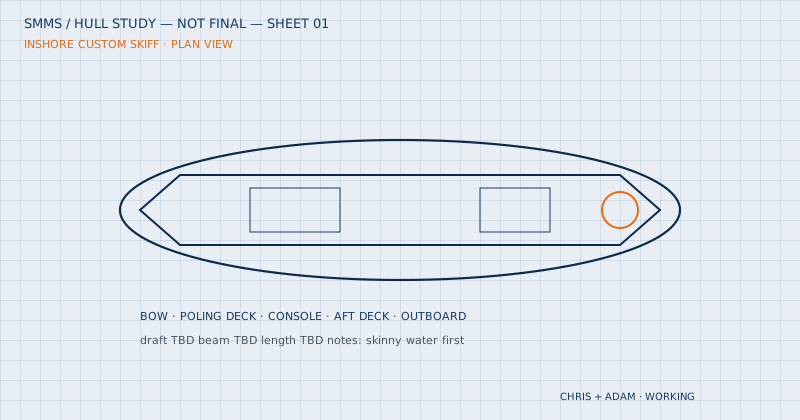
Working skiff plan

Study sheet. Deadrise, pad, and beam still open.

The variables that change the boat

Deadrise, running surface, chine, weight.

Deadrise

Angle of the V at the transom. Near 0–3° floats and poles skinny and slaps in chop. Twelve to fifteen degrees rides better and drafts more. Hell’s Bay has said it: the Professional is about 3° and mid-single-digit draft; the Marquesa lives closer to 12–15° and 8–10" depending on power.
Pad, tunnel, or V

A flattened aft pad helps the hull get up and track. A tunnel lets you raise the lower unit almost even with the keel and stay on plane over a long skinny stretch — you give up some speed and usually a little draft at rest. A modified-V is the mixed-water compromise.

Chine, transom, pounds

Split chines and a radiused transom are how builders chase a quiet pole and a dry run. Every extra pound is draft. Technical carbon hulls live 500–900 lb; a glass 18 with a 150 is often 1,400 lb rigged. Guides treat rigged weight as the real spec.

Adam’s method and the science of the boat

A 14-foot-6 pocket-drive candidate.

This is Adam’s method of working a hull — numbers first, then the shop. Small footprint, foam or plywood core, tunnel / pocket drive, almost no deadrise at the transom. It is not a SeaBound model yet. It is the first hull on the loft table because it matches the skinny-water job: low windage to pole, jack plate almost required, 25 hp happy and 40 hp max.

Plywood coreFoam core
LOA14' 6"14' 6"
Max beam6' 4"6' 4"
Hull draft (study, 400 lb load)4"3.25"
Hull weight600 lb375 lb
Displacement at that draft~1,000 lb~775 lb
Power25 recommended / 40 max25 / 40 max
MaterialComposite over plyComposite over foam

Why this bottom is on the table

Low chine at the bow and almost no transom deadrise — a backcountry tool, not a bay-crosser. Generous beam for the length so the waterplane keeps draft down and two anglers on a gunwale barely heel it. Tunnel moved forward with sponsons aft of the true transom for lift and hole shot. Designed waterline about 4" at ~980 lb. Self-bailing cockpit to about 1,300 lb. Garage-able. Wide 12" gunwales and a foredeck you can walk to the stem.

Pocket drive, not a cat tunnel

The study’s point: a cat-style tunnel throws away waterplane, so at the same weight it sits deeper, and the prop runs in aerated water. A pocket drive tapers — mouth higher than the exit — and compresses water onto the prop. Once primed, raise the engine on a jack plate and run in 4–5". Jack plate is not an option on this hull. Trim tabs help the tunnel’s trim change. No strakes in the stock lines so the hull stays quiet on the pole.

Build notes from Adam’s method we are weighing: foam sandwich is lighter and stiffer; plywood core punches harder. Kevlar in the inner skin is strength, not scrape armor — scrape armor is an extra outer layer and wants vacuum or infusion. Foam under the sole for reserve buoyancy. Keep fuel around 12 gallons under the casting deck. Do not pile weight in the stern. This is a second-boat project, not a first hull. Lines stay open until we decide if this is the skinny tool in a two-hull family — this one for mangrove and grass, a heavier modified-V for inlet and river.

Making the craft

From a pile of foam to a boat that poles quiet.

Adam wants a hull he would fish — not a brochure skiff. Light enough to pole all morning, honest enough to run skinny once the pocket is primed, built in a shop that already works on other people’s engines. That is why the method is open-mold foam sandwich: one-off, no factory female mold, every station checked before glass goes on.

A production skiff hides the work in a plug. A crafter stands the shape in wood, planks it, and lives with the lines until they are right. That is the science he is bringing to SeaBound — measure twice, wet out once, flip only when the outside skin can carry the hull.

What he is after

A 14'6" class pocket-drive that two adults can garage, pole, and run on 25–40 hp. Almost no transom deadrise so it sits on grass. Beam enough that two men on a gunwale do not roll it. Tunnel moved forward with sponsons aft so the hole shot is not a hole. Jack plate as part of the boat, not a catalog add-on. Quiet bottom — no strakes in the stock lines — because slap puts tailing fish down.

Why this method

Foam cuts and bends. Plywood fights you and then punches oyster better. Foam sandwich, done in epoxy, is how you get a 375-pound hull instead of a 600-pound one without buying a production tool. Open mold first so the loft learns the shape. Vacuum or infusion later on flats (sole, hatches) where bagging actually raises glass content and cuts fairing hours.

The loft sequence

01 — Stand the jig

Molds on a strongback, laser down the centerline, stations close enough that foam cannot sag — about 18" centers, not ten frames and hope. Plastic on the jig so resin never glues the boat to the shop. Transom often goes on now so the pocket and shaft height are locked before the first plank.

02 — Plank the shape

Divinycell, CoreCell, Airex, or Klegecell. Not NidaCore. Not house foam. Strips follow the mold. Fasten temporary. Fair the outside until the bottom looks like water, not stations. This is where a crafter earns the ride — a lump in the pocket is a lump in the prop forever.

03 — Outside skin

Epoxy only. Polyester and vinylester stay off this hull. Wood-boat epoxy is not automatically foam epoxy — Adam’s call is a two-phase resin that can post-cure. Wet the schedule the plans demand. Thicker skins than a ply-cored boat. That is the stiffness you paid the foam for.

04 — Flip and strip the jig

Cradle the hull, roll it, pull the wood. The outside skin is now the mold. Anything you rushed on the jig shows up as print-through or a soft spot. This is the last cheap chance to fix a station.

05 — Inside skin and bone

Glass the interior. Then structure, sole, tanks, electrical. Foam under the sole for reserve buoyancy. Fuel stays small and forward of the stern — about 12 gallons under the casting deck. Weight in the back kills the pocket.

06 — Deck, plate, pole

Deck the same way as the hull. Poling platform and forward platform are not trim — they are how you fish it. Jack plate and a 20" shaft so the cavitation plate can sit with the tunnel, then rise once the pocket is primed. Then you run water a brochure draft never promised.

Foam path

Light, stiff, garage-able. Puncture is the tax. Good for grass and pole days. Kevlar in the inner skin is strength. Scrape armor is a separate outer layer and wants a bag. Open-mold parts run about a third heavier than a bagged part — that is why flats (sole, hatches, stringers) get vacuum first.

Plywood-core path

Stitch-and-glue sandwich: marine ply as the core, epoxy and biaxial glass in and out. Cuts flat on the shop floor. No lofting, no scarf — glass splices. Bottom that takes grounding and stump. Heavier than foam. The abuse hull if the same lines work oyster and trailer bunks every week.

Shop rule

Tunnel and sponsons make this a second hull, not a first. Pick foam or ply before the first sheet is cut. Lines stay open until Adam would put his own name on the transom.

Two ways a skiff becomes a hull

Stitch-and-glue composite, or foam on a jig.

Serious one-off flats boats in this family of science come together two ways. Adam’s method uses both, for different jobs.

Stitch-and-glue plywood core

Cut expanded plates flat. Bend sides around a mid-frame or a simple 2x jig. Stitch seams with ties. Tape with epoxy and biaxial. Glass the whole hull in and out. Flip. Cut openings. Drop in a tunnel built as its own box — filleted corners, then tabbed into a recess ground in the bottom so the extra tape does not print a ridge. Frames can be ply or 1x3. Decks often start as the building base so nothing is wasted.

Open-mold foam sandwich

Foam has no stiffness until it is a sandwich, so the jig is denser — molds on the order of 18" with battens, not ten stations. Plank, fair the pocket, glass outside, flip, pull the wood, glass inside. Same chemistry: epoxy only. Same rule on the tunnel: grind a shallow rebate where the tunnel tape will land so the finished bottom stays fair. Hybrid shop: open-mold the hull, bag the flat parts.

The science the shop actually uses

Numbers that decide the boat before the first wet-out.

DWL and PPI

Designed waterline is a weight, not a wish. Draft is quoted at a displacement. Pounds per inch tells you what two adults and a cooler cost you in draft. A lightly loaded extreme-flats hull can sit a full inch higher than the published DWL. That is why we will never advertise empty-hull inches.

Pocket, not cat tunnel

A split-hull cat has less waterplane, so at the same weight it sits deeper, and the prop runs dirty water. A pocket tapers — mouth high, exit lower — and compresses a hump onto the plate once you are on plane. Prop deeper for the hole shot. Jack plate up after it primes. That is the 4–5" running story.

Developable panels

A good one-off skiff is drawn so sides and bottom unroll onto 4x8 sheets. No compound curve you have to fight. That is why a first hull in this family can be a stitch-and-glue 14, and why a 15 with a tunnel is a second hull — the pocket is the compound work.

Upright flotation

Pour two-part foam under the sole and in dead spaces until the boat floats upright swamped. On a boat this size that is not optional in the States. Two to four gallons of pour foam is the usual kit on a small skiff; more if the core is plywood instead of already-buoyant foam.

Shaft, plate, pocket

Transoms start at 15" or 20" and get blocked for the shaft you actually hang. Cavitation plate flush with the tunnel roof at install, then the jack plate lets you climb. A shallow-water lower unit is a bonus. Trim tabs earn their keep on a tunnel because the pocket changes trim.

Weight in the stern

Livewell, battery, and tackle aft will sit the pocket down and kill the hole shot. Fuel under the casting deck, small tank. Layout can move — framing spacing cannot.

Hull families in this science

Pick the job. Then pick the length.

The same shop tradition that produced the 15-foot pocket hull also draws a ladder of skiffs. We are not selling a catalog. We are using the ladder so Adam and Chris choose a family, not a miracle bottom.

ClassJobWhat the numbers teach
Micro / solo 13–14One or two, tiller, first hullLow sheer, small hp, foam under the sole. A first project. Not a tunnel.
Phantom-class 15–18Pole and sneak, two anglersWide for the length. 15 is the skinny tool with a pocket. 16 and 18 add people and a little ride — and draft.
Narrow stalker ~18Everglades-style poleBeam comes off so it poles. Stability is the tax. Not the boat for two on a gunwale.
Extreme flats 20–22Run skinny for distancePocket drive as a family. DWL 2–4". Guides asked for room. Still not a bay-crosser if freeboard is cut.
Texas scooter / sledLong skinny flats, low freeboardSame pocket idea, freeboard taken down for poling and wind. Protected water only.
Named bottoms — study notes, not inventory

How the hulls fishermen actually name behave.

HullBottomDraft (treat as optimistic)JobGives up
Hell’s Bay Professional~3° / nearly flat~4.5–6"Pole-first skinny, 1–2 anglersRide in a stand-up bay
Hell’s Bay Marquesa~12–15°, later running pad~7–10" riggedOpen-water technical, more fuelLast inches of grass
Maverick 17 HPX-SSkinny “S” package~6"Draft plus some ride in a 17Load and range vs an 18
Maverick 17/18 HPX-VModified-V (~13° on the 18)~8–10"Keys, mixed days, Pine IslandNot a tunnel; not 5"
Maverick HPX-TTunnel~5–8" runningLong skinny runsChop ride vs the V
Chittum Islamorada 18 — 2° SSSuper-shallow~5–7" classPole and sneakSame ride tax as any 2°
Chittum Islamorada 18 — 12°More V, split chine, radiused transoma bit more draftDry run + quiet pole (their brief)Not the skinniest SS

Maverick owners on the builder forum are blunt: Keys or Pine Island Sound — take the V. Water you have to run for miles in a foot — take the T. The S tries to steal both. Nobody who fishes both water types believes that is free.

What the water asks for

Four jobs. Four compromises.

Backcountry marsh

Mangrove & 10,000 Islands

Cuts, oyster, water that leaves at low. Priority is draft on plane and at rest, a hull that poles without slapping, and a lower unit you can pick up. Tunnel plus jack plate helps you run skinny; a light technical bottom helps you pole skinny. Those are not the same boat.

Coastal inlet

Inlets, ICW & oyster bars

St. Augustine bars and inlet chop. Enough entry and spray rail to stay dry on the run, and a bottom that will take oyster. A pure 4.5-inch technical skiff is miserable here. A mid-draft modified-V with a jack plate is what most working anglers keep.

Wide river

River tide & fetch

St. Johns pace: wind stacks, tide runs, the ride home gets ugly. Beam and a little deadrise matter more than another inch of draft. Forum guys who split creeks and the river want a hull that poles the creek and does not beat them to death on the river.

Sight fishing

Open flat, sight fish

The magazine skiff. Elevated bow deck, real poling platform with a step, silent chine, low freeboard so you can see. Weight under 1,500 lb rigged if you expect to pole all day. Livewell and under-gunwale racks if you are not fly-only.

What shows up on every serious spec list

Build features, not chrome.

Honest draft

Quote it rigged: engine, fuel, two adults. Empty-hull inches are advertising.

Pole and deck

Stern platform with a step. Forward deck you can stand on all morning. Pole holders that do not rattle.

Jack plate & pickup

If the boat is meant to run thin, the plate and low-water pickup are part of the hull, not extras.

Power-Pole ready

Transom and bank spec’d for a shallow-water anchor so house voltage does not die when it fires.

Quiet bottom

Chine and transom work that does not slap. Light laminate for all-day pole; tougher glass if the job is oyster and a long run.

Fish layout

Under-gunwale racks, a livewell that circulates, dry boxes you can open with a rod in the other hand. Console that does not steal the bow.

A hull family — not one miracle bottom

Why one skiff for Florida is a lie.

Hal Chittum’s filter is the right one: the boat must float level loaded, stay quiet on the pole, and run dry. If a hull only does one of those, it is a specialty tool, not a line.

The loft plan

Find a hull we would fish. Then build a few.

  1. Lock a small family of inshore hulls — not a 28-foot bay boat with a skiff sticker.
  2. Build with local hands who already fish mangrove, oyster, river, and flat.
  3. The same shop that comes to your dock will know the boat because we built it.
  4. No deposits and no wait list until a hull is chosen and a shop can stand behind the number on the spec sheet.

If you fish for a living or close to it and want a say before lines freeze, call the shop and say skiff loft.

Call (904) 200-2117 Email the shop